Solutions
Your team's work is scattered. We build the system that pulls it together.
Requests arrive by email. Status lives in someone's head. Dashboards exist, but nobody trusts them. Every solution below starts from exactly that situation — with AI where it earns its place and auditable rules everywhere else.
21 days
work-order to go-live, validation-gated
1 thread
per order — email, WhatsApp, website, portal, phone — evidence and live updates all the way to invoice
Yours
fully customized workflow, automation, and SLAs — you're never forced into ours
$990/mo
all-in for teams of 1–10, in CAD
0
missed emails, lost attachments, or surprise auto-replies
01
“Work arrives everywhere and gets lost.”
Orders come in by email, WhatsApp, and your website — and they all funnel into one shared Gmail that can't thread the follow-ups under the order they belong to. That's how shipments get lost.
One Thread Per Order
Every channel — email, your website, a branded customer portal — produces the same owned, SLA-tracked order, with every follow-up, notification, and document consolidated under it. What a shared inbox structurally can't do.
Vendor-Aware Intake & Triage
Orders auto-categorized and converted by vendor and order type — a national-network linehaul doesn't follow the same workflow as a same-day local, and the system knows the difference.
02
“Nobody can see what's at risk.”
Dashboards exist, but they show ticket counts — not which commitment breaks next.
SLA & Queue Dashboards
Today's work, overdue work, exceptions, and SLA performance in one attention board your team actually trusts.
Workflow Audit / Diagnostic
Field drift, workflow complexity, SLA gaps, permission risk, and dashboard noise — surfaced before they hurt.
03
“People are doing what software should.”
Copying fields, chasing status, retyping documents — hours of judgment spent on work that has rules.
Workflow Automation
Deterministic automations for intake, classification, field population, and routing — auditable rules, not black boxes.
AI Assistants & Document Intelligence
AI that reads invoices, documents, and requests with a visible confidence score on every field — and routes anything uncertain to a human before it counts.
04
“We've outgrown our setup.”
The tools grew organically. Now permissions, documentation, and administration are nobody's job — and everybody's problem.
Permission & Governance Audit
Groups, roles, unified permission schemes, and sharing rules your auditors can follow.
Managed Operations
Ongoing administration, automation tuning, dashboard optimization, and SLA monitoring — so the system keeps earning trust.
Knowledge & SOP Systems
Policies, FAQs, operations manuals, and training guides with one documented source of truth.
05
“We need something custom.”
Off-the-shelf stops short of how your operation actually runs.
Operational Command Consoles
Custom command layers that hide tooling complexity behind operator-ready UX — the pattern behind our Courier / Logistics Control Tower.
The Control Tower
How a full implementation looks.
Before
A courier operation running on a shared inbox: dispatch requests buried in reply chains, delivery evidence detached from billing, SLA breaches discovered after the customer called, and status that lived in whoever answered the phone.
After
Every email becomes an owned, SLA-tracked order. Live queues show today's pickups, overdue work, and exceptions. Evidence stays attached from pickup to invoice. Permissions, dashboards, and documentation hold it all to account — one command layer, end to end.
That architecture didn't stop at one client — it became OpsFlowHub, our shipment command console. See OpsFlowHub →
The solution, as a story
Follow one request through the Control Tower.
The unified service architecture behind our courier, 3PL, and supply-chain work — told the way it actually happens, from the moment a request arrives to the dashboard leadership reads.
Scene 01
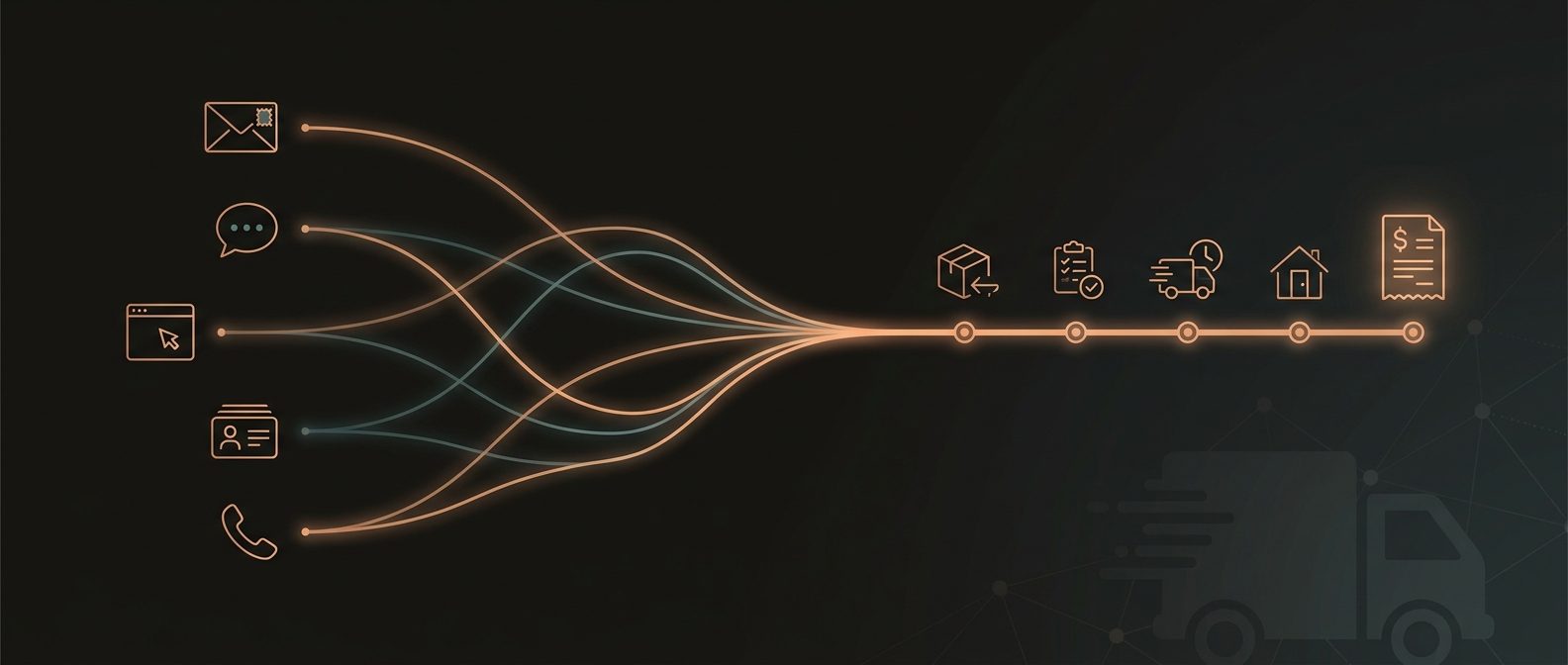
An order arrives — from anywhere. It gets one thread.
A shared Gmail can't tag every reply, notification, and document to the order it belongs to — that's how shipments get lost. Here, every channel produces the same owned, SLA-tracked order, auto-triaged by vendor and order type, with every follow-up consolidated under it.
Scene 02
The tower routes it — instantly, to the right hub.
Three governed hubs share one automation layer: cross-hub triggers, a unified SLA engine, email-to-order consolidation, and REST/webhooks into ERP and fleet tracking.
Customer Hub
- Quotes & pickup requests
- Billing & accounts
- Onboarding
SLA First response on quotes ≤ 2h
Automation Auto-assign, acknowledge, keep the customer updated
HR & Admin Hub
- Time-off requests
- Reimbursements
- Timesheets
SLA Manager approval ≤ 8h
Automation Smart approver routing, reminders, payroll sync
Operations Hub
- Delivery issues
- Fleet maintenance
- Warehouse tasks
SLA Resolution ≤ 24h
Automation Root-cause capture, breach alerts, dispatch notifications
Scene 03
The workflow is yours — designed, automated, and SLA-clocked.
Most tools hand you a fixed workflow and make your operation bend around it. We do the opposite: designing your end-to-end workflow is the consultancy at the heart of every implementation — every stage, branch, exception path, and notification built around how your business actually runs.
Designed with you
We map your real operation — intake to invoice — and build the workflow to match it, exceptions and cancellations included. Workflow design is part of the one-time fee, not an add-on.
Automated end to end
Notifications at every step — dispatch, driver, exception, POD, invoice — with BOL, waybill, POD, photos, and release letters attached to the order all the way to billing. Outbound messages to the network you carry for are always deliberate, agent-triggered.
SLA on every step
Every stage gets a clock, because a commitment without a clock is invisible risk. Breach alerts escalate before the customer feels the delay — real-time, evidence-backed, auditable.
Scene 04
SLA clocks run the whole time — as many as your operation needs.
A typical build starts with four — intake response, dispatch, pickup, delivery — each with automated escalation. But we define them with you, around your contracts and service levels: same-day vs. linehaul, per-customer, per-region. Dispatchers see risk before the customer calls.
A typical starting set
Scene 05
Leadership reads one truth — and your customers see theirs.
Executive, operations, HR, and customer views, all derived from the same live data. Your customers track their own orders and communicate through your branded portal — fewer where-is-my-shipment calls, more trust.
Command view · live
All queues current
Today's pickups
24
on schedule
SLA at risk
3
escalated to leads
Exceptions in recovery
2
retry scheduled
Invoice-ready
11
POD complete
Illustrative counts — every role reads the same live data, from the CEO's KPI board to the customer tracking one shipment.
Storyboard recreated for presentation. The production implementation runs privately for a courier operator — customer screens and data are never published.
Why not just another cloud tool?
Generic tools give you software. This gives you a running operation.
Built for the carriers who deliver for national networks — Purolator, UPS, Apple Express and similar contracts — where a lost email is a lost shipment and a missed SLA is a contract risk. The gap between “we bought a tool” and “our operation runs on it” is where projects die; we close it by delivering the system configured, automated, and validated against your real workflows.
One thread per order — the shared-inbox killer
Orders arrive by email, WhatsApp, and your website, and a shared Gmail can't hold the follow-ups together. Here every communication, notification, POD, and invoice lives under one order, end to end — zero missed emails, zero lost attachments, and an audit trail that settles disputes.
Email triage that actually holds
Our reference configuration has processed 14,000+ email-intake items — every message consolidated under its parent order with ownership and an SLA clock, not another shared-inbox graveyard.
Your customers get their own portal — unlimited, free
A branded portal where customers submit, track, and discuss their orders with automatic status notifications — and portal users are unlimited at no per-customer charge, unlike most logistics SaaS.
Live in 21 days, not quarters
A phased go-live plan with validation gates at every step — Phase 1 takes you from work-order to running system in 21 days.
A deterministic core with Rovo AI on top
Auditable rules run status, money, and compliance; Rovo — included in the Atlassian Service Collection at no extra cost — layers on knowledge suggestions and drafted replies your agents approve.
No lock-in, real scale
Built on Atlassian standards any admin can maintain — and the same architecture scales from a 13-seat team to hundreds of agents, adding hubs instead of re-platforming.
How we engage
Where to start — and how fast it lands.
01
Working session
One call. You describe the mess; we map it to a system and give you our read — in plain language.
02
Fixed-scope Phase 1
A transparent proposal, then the 21-day plan below — delivered with Agile discipline: short validated increments, a visible gate at every phase, no big-bang surprises.
03
Operate & extend
We run and tune what we built — then extend into Rovo assistance, forecasting, and the OpsFlowHub console as your operation grows.
Every implementation includes — at minimum:
- Customer, HR & Operations ticketing lifecycles — all three hubs, configured
- Email intake with order detection and one-thread consolidation
- SLA framework with breach alerts and escalation
- Dashboards and operational queues (today's jobs, overdue, exceptions)
- Attachments governance — BOL, waybill, POD, photos, release letters
- Controlled notifications, training, and documentation
Phase 1: twenty-one days from work-order to go-live.
The phased plan our reference implementation ran — each phase gated by its own validation before the next begins.
Days 1–5
Foundation
Hubs, request types, workflows, and permissions configured to your operation.
Days 6–10
Automation
Intake routing, auto-assignment, SLA clocks, and escalation rules wired in.
Days 11–14
Portal
One front door for customers and staff — submission, tracking, knowledge base.
Days 15–18
Dashboards
Executive, operations, and SLA views built on live data.
Days 19–21
UAT & go-live
Your team validates against real scenarios; training and documentation included.
Investment
Simple pricing, in Canadian dollars.
One fixed implementation fee, one all-in monthly rate. No percentage of revenue, no long contract, no per-customer portal fees.
Phase 1 implementation
From $4,995 CAD
one-time, fixed scope
Production-ready setup for teams up to 10 users — Customer, HR, and Operations hubs all included, not priced separately. Every customization included: workflow design, SLAs, automation, notifications, dashboards, reporting, portal branding, and training. Larger operations scoped in your proposal.
All-in monthly
From $990 CAD
per month, total — teams of 1–10 users
Everything to run and grow the system: platform licensing (Atlassian Service Collection, Confluence, ScriptRunner), managed support, and 10 hours of customization every month — one CAD invoice, no surprise USD conversions, no per-customer portal fees.
You approve before you finish paying
UAT sign-off gates the final payment milestone — you accept the working system before the engagement closes, not after.
Limited implementations per quarter
Every Phase 1 is founder-led, not handed to a bench. We take on a limited number of implementations at a time so each one gets that attention.
Prices exclude applicable taxes (HST/GST). Exact figures land in your Phase 1 proposal — before you commit to anything.
After go-live
The system that keeps getting smarter.
Phase 1 gives you the running operation. The same architecture then extends — without re-platforming.
Rovo AI (Atlassian Service Collection)
Knowledge suggestions, drafted replies, and AI agents inside the hubs your team already works in — included with the Service Collection, and always assistance, never the system of record.
Forecasting
Volume and SLA-risk forecasting built on the operational data the Control Tower already captures — see next week's crunch before it arrives.
Integrations that end double entry
ScriptRunner-powered rate engines and REST/webhook connections into accounting (QuickBooks) and TMS platforms — plus mobile driver capture on the roadmap. Your systems stop disagreeing with each other.
OpsFlowHub command console
Our Forge-built product layer: one deterministic view per shipment — status, evidence, SLA risk, next action — on the Jira you already run.
Questions, answered
How do Quanfey engagements start?
With a working session. You bring the workflow that hurts; you leave with a clear read on how to fix it. First delivery is a fixed-scope slice, not a long contract.
How is this different from other cloud tools?
Generic cloud tools give you software; we deliver a running operation. The Control Tower arrives configured to your workflows — intake, SLAs, dashboards, governance — on the Atlassian platform, so you're never locked into a proprietary vendor and any Jira admin can maintain it.
Is there a clear implementation path?
Yes — a phased, fixed-scope go-live plan: foundation, automation, portal, dashboards, then user acceptance testing, each with its own validation gate. Phase 1 runs 21 days from work-order to go-live.
How long does it take an owner to decide?
Typically about a week. The working session is day one; within days you have a fixed-scope proposal with transparent pricing and the phased plan — enough to say yes or no without a drawn-out sales cycle.
Can it scale and be customized to our operation?
Yes. The three-hub architecture is a pattern, not a template — hubs, request types, SLAs, and automations are built around your operation, and the same platform scales from a 13-seat team to hundreds of agents without re-platforming.
What does it cost?
Implementation from $4,995 CAD one-time (up to 10 users) — with all customization included: workflow design, SLAs, automation, notifications, dashboards, and reporting. Then from $990 CAD per month total for teams of 1–10 users, covering platform licensing, managed support, and 10 hours of monthly customization. Taxes extra; exact figures in your Phase 1 proposal. No percentage-of-revenue, no long contract.
What platform is it built on?
Atlassian's Service Collection — the platform formerly sold as Jira Service Management, now bundled with Customer Service Management, Assets, and Rovo AI at the same price. It's the same platform trusted by 100,000+ organizations, including global logistics leaders. You own the subscription; we architect and run the system on it.
Do you use AI in operational logic?
Where it earns its place. Status, money, and compliance run on deterministic, auditable rules. AI — including Rovo assistance and document intelligence — handles reading, drafting, and classification, with humans in the loop.
Have you delivered this before?
Yes. Our Courier / Logistics Control Tower runs a real courier operation end to end — intake, workflows, SLAs, dashboards, and governance — and OpsFlowHub, our command-console product, grew directly out of it.
Next
Tell us where work is getting lost.
A shared inbox, an SLA blind spot, a document pile, a permissions mess — two sentences is enough. We'll reply within one business day.